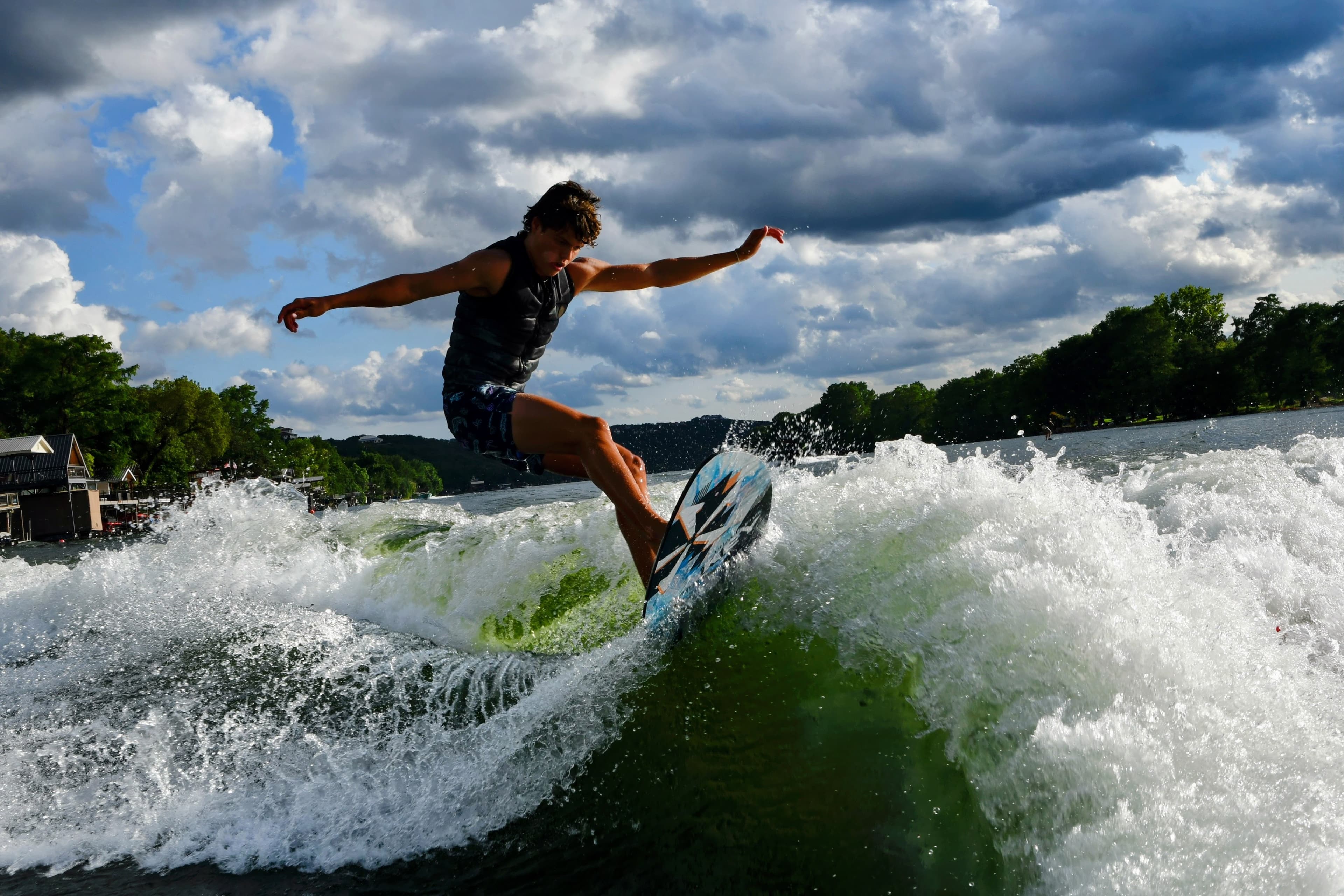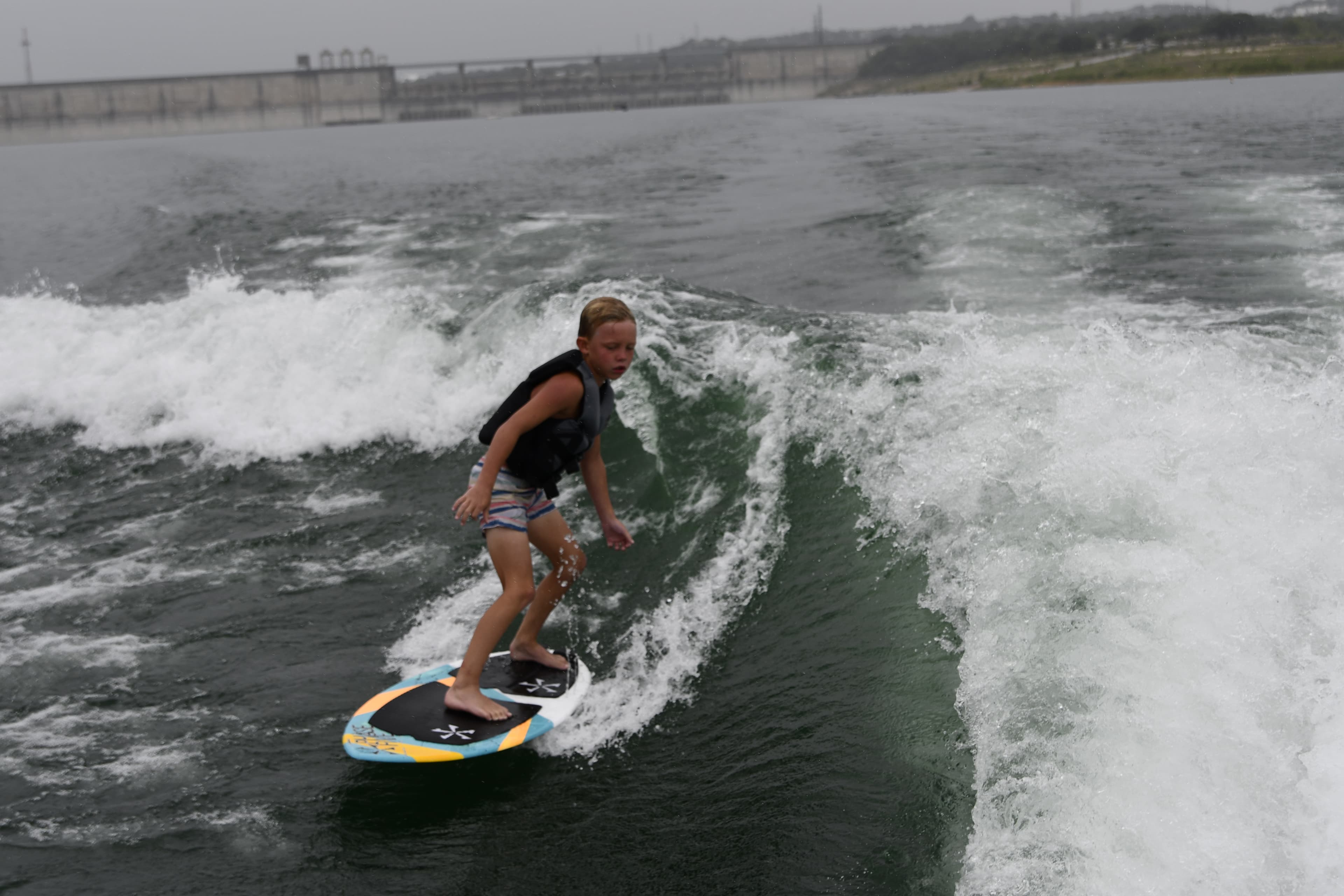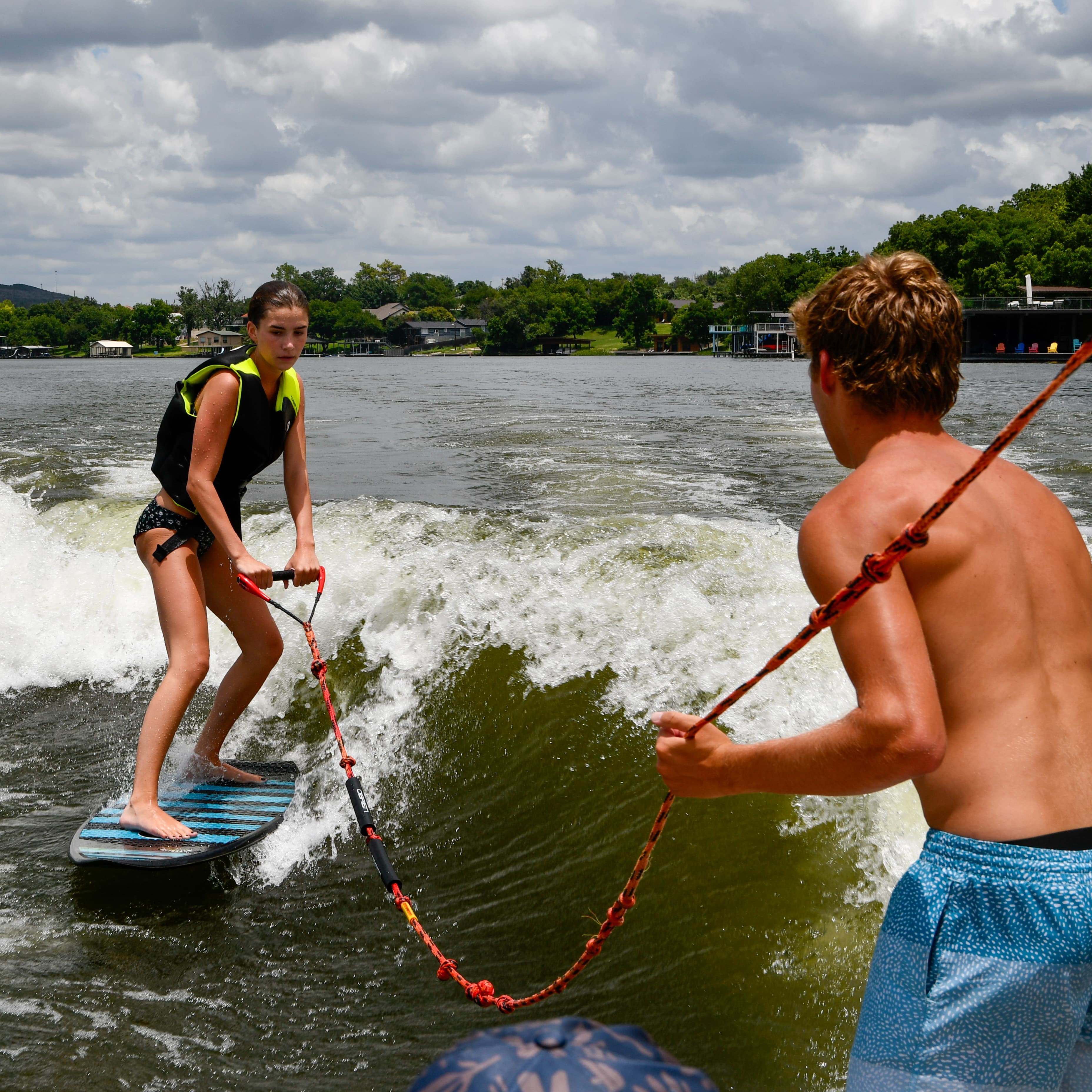
Wakesurfing is a tow-watersport where a rider surfs the continuous wake produced behind a specialized boat at low speed — typically 10–12 mph — without being attached to the rope after the initial start, making it one of the most accessible water sports for first-timers of any age or fitness level.
At Board Bound Wake Co, we have coached hundreds of first-time riders on Lake Austin and Lake Travis, and the pattern is consistent: with the right setup, the right board, and a few coached attempts, most people are riding rope-free within a single session. Here is what that process actually looks like.
What Gear Do You Need to Wakesurf?
You do not need to bring anything. At Board Bound Wake Co, every private lesson includes professional-grade wakesurf boards in multiple sizes, US Coast Guard-approved life vests, and a premium wake boat with a dialed-in wave system. Your only job is to show up ready to get wet.
That said, understanding the gear helps you learn faster.
Board Size and Style
| Rider Weight | Recommended Board Length | Style |
|---|---|---|
| Under 120 lbs | 4'8" – 5'0" | Surf or skim |
| 120–180 lbs | 5'0" – 5'6" | Surf (wider, more foam) |
| 180 lbs + | 5'4" – 5'10" | Surf (maximum volume) |
Beginners almost always learn faster on a surf-style board — wider, thicker, and more buoyant than a skim-style board. We select the right board for each rider before the lesson starts.
Life Vest
A properly fitted life vest is non-negotiable and is required by Texas law on all navigable water for riders under 13. We carry vests in all sizes. The vest should be snug but allow full arm movement — if it rides up over your chin in the water, it is too loose.
Before You Hit the Water: On-Boat Drills
Every lesson at Board Bound Wake Co starts with a safety briefing and on-boat drills. This is not just formality — riders who practice stance and pop on the deck of the boat before getting in the water stand up 30–50% faster in our experience.
What we cover in the dry-land drill:
- Correct foot position (regular vs. goofy stance)
- Where to place your hands on the rope
- How to keep your knees bent and weight centered
- The "sit in a chair" starting position in the water
- Hand signals for speed up, slow down, and stop
Learning the hand signals is especially important. Once you are in the water behind a running boat, verbal communication is nearly impossible. We use a standard set of signals — thumbs up for more speed, thumbs down for less, and a flat hand across the throat to stop. Knowing these signals before you get in the water keeps you in control of the ride.
Step-by-Step: Your First Wakesurf Start
Step 1 — Enter the Water and Get into Position
Slide off the back of the boat with the board already on your feet (we help strap you in). Float on your back with your knees pulled toward your chest. The rope should rest loosely across your shins, not gripped yet.
Step 2 — Grip the Rope and Signal Ready
Grab the handle with both hands, about hip-width apart. Give the captain a thumbs-up when you are set. Your heels should be on the board's edge and your arms should be straight but relaxed — do not try to pull yourself up with your arms.
Step 3 — Let the Boat Do the Work
As the boat accelerates, resist the urge to stand up early. Stay in the "chair" position — hips low, knees bent, board angled 45 degrees toward the surface. The boat will lift you. Your only job in this moment is to keep your core tight and your weight slightly back.
Step 4 — Rise to Your Feet
Once the board breaks the surface and you feel stable, gradually stand up by pressing through your heels and straightening your legs. Keep your eyes on the horizon, not on your feet. This is the single biggest technical mistake beginners make — looking down shifts your weight forward and causes nose dives.
Step 5 — Find Your Position in the Wave
Once you are upright, move toward the sweet spot of the wave — typically about 6 to 8 feet behind the boat's swim platform. You will feel a natural push from the water when you are in the right zone. This is called wave pressure, and finding it is the moment everything clicks.
Step 6 — Drop the Rope
When you feel steady wave pressure under the board, toss the rope handle toward the boat. The wave will hold you. Bend your knees, shift your weight slightly to your back foot to slow down, or to your front foot to speed up. You are wakesurfing.
Common First-Session Mistakes (and How to Fix Them)
Standing up too early — Stay patient in the chair position until the board is fully on top of the water. Jumping to your feet before the boat has fully pulled you up almost always results in a face-plant.
Locking your knees — Straight knees equal a rigid body equal a fall. Keep a soft bend at all times, even once you are riding.
Pulling with your arms — Your arms are just along for the ride on the rope. The moment you try to muscle yourself up, you will lose balance. Think of your arms as guide rails, not engines.
Riding too far back in the wave — If you keep falling off the back, you are outside the wave's push zone. Bend your front knee to add pressure and slide forward in the wave.
Wrong foot forward — Some people do not know their stance until they try it. If everything feels awkward, try the opposite foot forward. Roughly 75% of people are regular-footed (left foot forward), but plenty of natural wakesurfers are goofy (right foot forward).
What to Expect by the End of Your Session
Most first-timers hit these milestones within a standard lesson:
- First successful water start — usually within the first 3–5 attempts
- Riding with rope in hand — within the first 20–30 minutes
- Dropping the rope for 5+ seconds — often within the first hour
- Consistent rope-free riding — by the end of a 2-hour lesson for most riders
If you book a 3-hour private lesson, we have enough time to cover basic wave positioning, introduce small weight-shift turns, and work on consistency — all in a single session.
Why Lake Austin and Lake Travis Are Ideal for Learning
Lake Austin is a narrow, calm reservoir on the Colorado River running through Austin — its protected banks and minimal boat traffic during morning hours mean glass-smooth water that is nearly perfect for beginners. Lake Travis, a 19,000-acre reservoir approximately 64 miles long in the Texas hill country northwest of Austin, offers deeper open-water sections and consistent conditions throughout the day.
We run lessons on both lakes depending on availability, group size, and conditions. Our captains know both lakes well and choose the best stretch of water for each session.
Ready to Give It a Try?
The fastest way to learn to wakesurf is with coaching — not YouTube. A certified instructor watching your body position in real time can fix in two attempts what takes solo learners a full day to figure out on their own.
Book a private wakesurf lesson with Board Bound Wake Co and we will have you riding rope-free before the session is over. If you want to make a full day of it for the whole family, check out our private boat charters — lessons can be combined with a charter for the ultimate lake day experience.
Frequently asked questions
- How long does it take to learn to wakesurf for the first time?
- Most beginners achieve their first successful water start within 3 to 5 attempts and are riding rope-free within one to two hours of coached instruction. A 2- or 3-hour private lesson is enough time for most people to get comfortable surfing the wave independently.
- Do I need to know how to swim to wakesurf?
- You do not need to be a strong swimmer. You will be wearing a US Coast Guard-approved life vest at all times, which keeps you afloat comfortably. Basic comfort in the water is helpful, but you do not need swimming ability to participate safely.
- What is the difference between regular and goofy stance in wakesurfing?
- Regular stance means your left foot is forward on the board; goofy stance means your right foot is forward. Neither is better — it comes down to which feels natural to you. Most people are regular-footed, but your instructor can help you figure out your stance quickly on land before you get in the water.
- Can I learn to wakesurf on Lake Austin or do I need to go to Lake Travis?
- Both lakes are excellent for learning. Lake Austin's protected banks and calm morning water make it especially beginner-friendly. Lake Travis offers more open water and is great for longer sessions. Board Bound Wake Co runs lessons on both lakes, and your captain will help choose the best location based on conditions and group size.