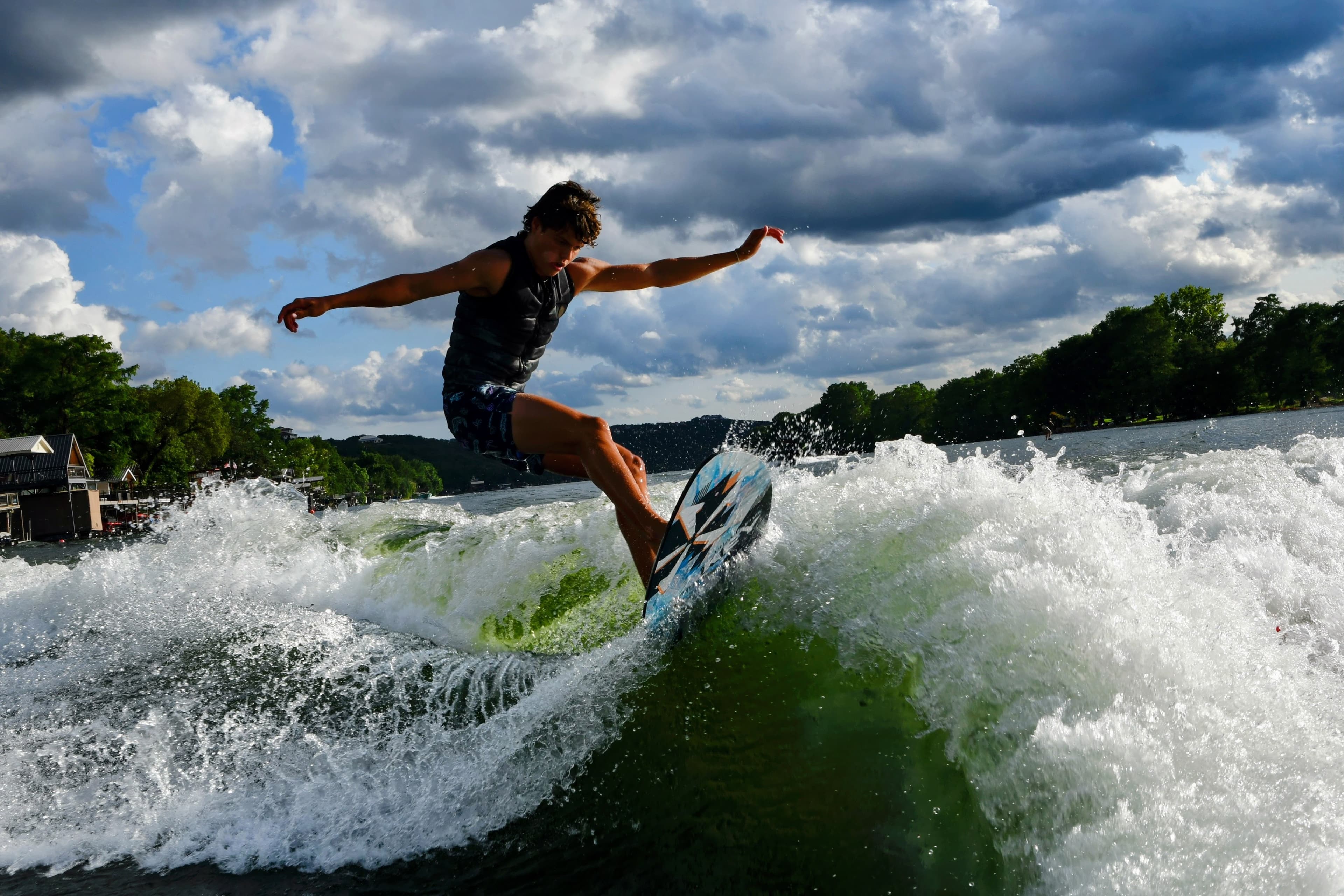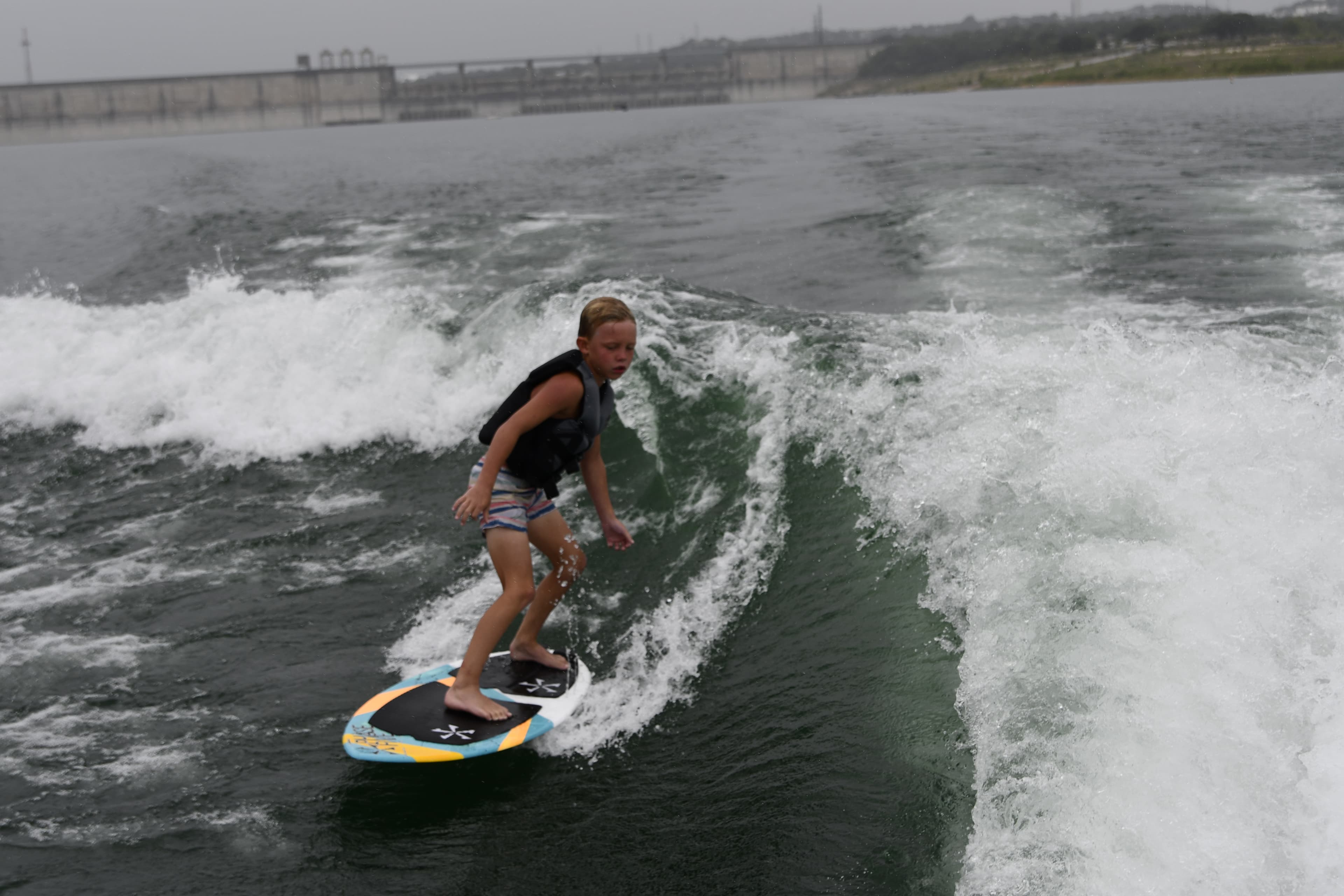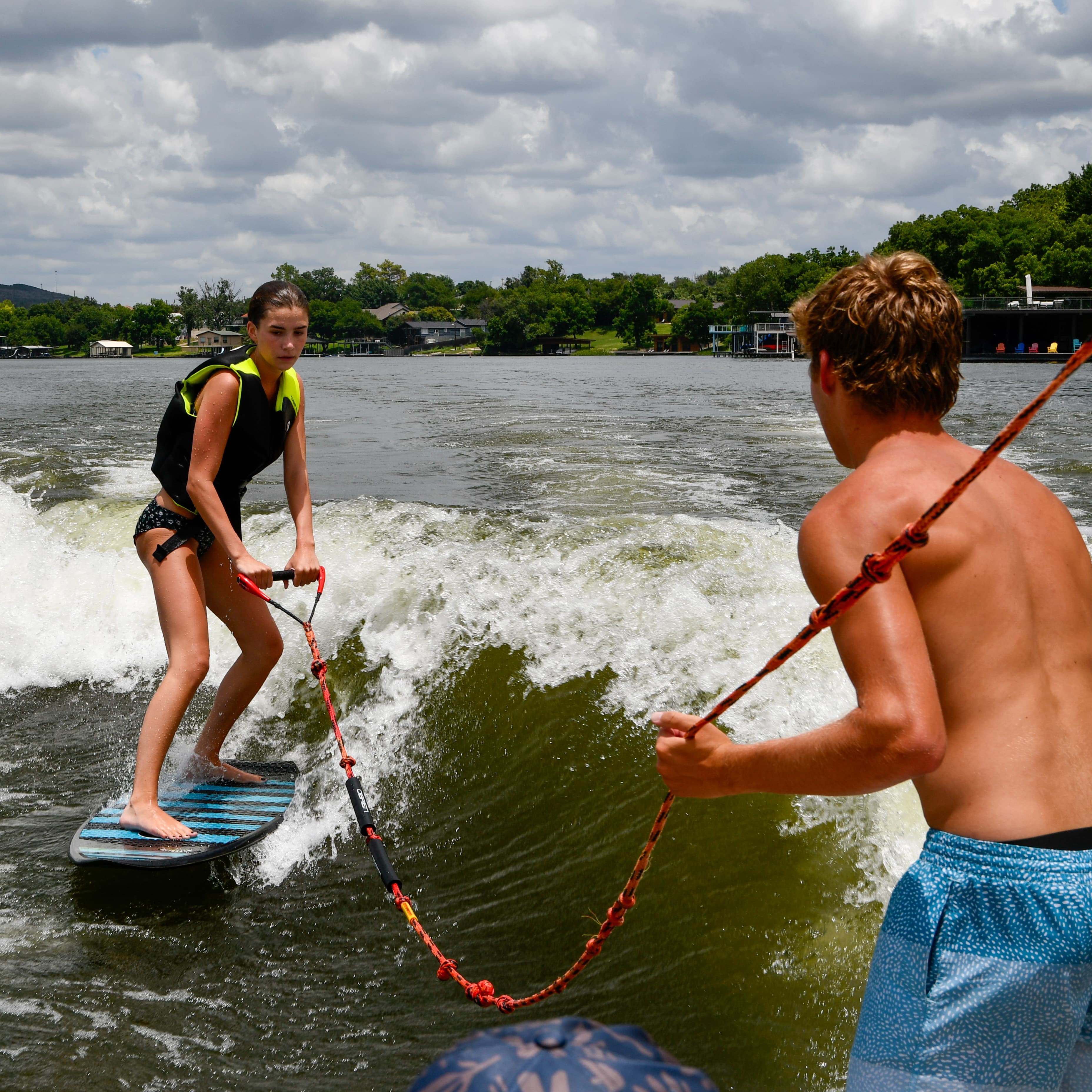
Wakesurfing is a tow watersport in which a rider surfs the continuous wave produced behind a wake boat, and most beginners can get up and ride within a single session when they start with the right technique and a patient instructor.
At Board Bound Wake Co, we take first-timers from flat-water nervous to wave-riding grinning every week on Lake Austin and Lake Travis. This guide covers everything you need to know before you step on the boat — gear, posture, captain signals, and what the first hour actually looks like.
What Gear Do You Actually Need?
The short answer: nothing. We provide all equipment on every private lesson — boards, fins, ropes, and US Coast Guard-approved life vests in sizes that fit. Here is what we put beginners on:
- Board size: Larger, wider boards (typically 5'0"–5'6") float higher and are far more forgiving for new riders. Smaller performance shapes come later.
- Fins: Three-fin setups give stability. Beginners do not need a single-fin performance shape.
- Rope: A wakesurf rope is shorter and thicker than a ski rope, with a soft handle. Never use a standard water ski rope — it can reach the propeller zone. (USCG boating safety guidelines explain the equipment distinctions.)
- Life vest: Required and non-negotiable. We stock USCG-approved vests for all body types.
How to Learn to Wakesurf in One Session
Step 1: Watch the Safety Briefing — All of It
Every Board Bound session opens with a comprehensive safety briefing before anyone touches the water. Pay attention to:
- Where not to swim relative to the boat (never approach the stern while the engine is running)
- The hand signals you will use to communicate with the captain
- How to fall safely (arms out, away from the boat)
This is not a formality. Knowing the rules makes everything on the water faster and more fun.
Step 2: Do the Land Drills on the Boat
Before you enter the water, we run through stance and balance on the deck. This saves time and reps once you are in the lake.
Key points to nail on land:
- Identify whether you are regular (left foot forward) or goofy (right foot forward). Not sure? Think of which foot you'd kick a ball with — that is your back foot on a wakesurf board.
- Practice a wide, athletic stance — knees bent, hips low, weight slightly forward.
- Simulate pulling on the rope: both hands, elbows in, do not yank.
Step 3: Enter the Water and Set Your Start Position
This is where most beginners overthink it. Keep it simple:
- Float on your back with the board on your feet, toes up, heels pressing gently on the board.
- Keep knees bent toward your chest — think of a cannonball that hasn't launched yet.
- Hold the rope handle with both hands, arms straight but relaxed.
- Let the rope go slack toward the boat. Do not tense up.
Tell the captain you are ready with a thumbs up.
Step 4: Let the Boat Do the Work
This is the single most important lesson. Beginners consistently try to muscle themselves up. That is wrong.
As the boat accelerates:
- Keep your knees pulled in until you feel the board begin to plane.
- Only then start to extend your legs slowly — think of standing up from a low chair, not jumping.
- Keep your weight back slightly until the board comes to the surface, then shift forward to level out.
- Look at the horizon, not down at your feet.
If you are getting yanked forward: you are extending too fast.
If you are getting dragged face-first: your heels are not pressed enough into the board.
Step 5: Find Your Pocket on the Wave
Once you are standing, the goal is to position yourself in the pocket — the curved, highest-energy part of the wave just behind the boat's curl.
- Move toward the boat by leaning your front foot forward (toes down, flex your ankle).
- Move away by pressing your back foot and letting the rope pull you back.
- The rope should feel light, almost slack, when you are in the right spot.
The boat speed on Lake Austin and Lake Travis is dialed to create a clean, consistent wave — trust it.
Step 6: Learn the Captain Signals
You and your captain need to communicate cleanly. Here are the standard signals we use:
| Signal | Meaning |
|---|---|
| Thumbs up | Speed up / I'm ready |
| Thumbs down | Slow down |
| Hand across throat | Stop / cut the engine |
| Hands on head | I'm okay after a fall |
| Point left or right | Turn the boat that direction |
Never shout — at boat speed and with music playing, nobody hears you. Signals only.
Step 7: Expect to Fall — and Learn From Each One
Falling is part of the first session. The riders who improve fastest are the ones who stay curious about why they fell, not embarrassed that they did.
Our instructors record your sessions on the water. The video review at the end of each lesson is often where the biggest lightbulb moments happen — you can see your posture, your timing, and exactly where things went sideways.
Common beginner falls and their causes:
- Tipping forward: Weight too far forward when standing up — keep it centered.
- Board shooting out behind you: You extended your legs before the board planed — slow down that extension.
- Losing the wave: You drifted too far back in the pocket — shift weight forward.
What Makes Lake Austin and Lake Travis Good Learning Lakes?
Both lakes are excellent for beginners, and we run sessions on both depending on the season and water conditions.
- Lake Austin is a narrower, calmer river-reservoir ideal for flat water and consistent boat runs — great for that first session.
- Lake Travis is a wide-open 19,000-acre reservoir with deep, clear water and room to run long straightaways without repeated turns.
Both give you plenty of space to find the wave, make corrections, and build confidence without fighting choppy water. Book a private lesson and we will recommend the better lake for your session date.
How Long Before You Can Drop the Rope?
Going rope-free is a separate milestone — we cover it in depth in our guide on how to wakesurf without a rope. For now, the goal of session one is simple: get up, find the pocket, and stay there for a 10-second ride. Most people hit that by the end of a two-hour lesson. Some get there in the first 30 minutes on the water.
Ready to Get on the Water?
The fastest way to learn is with an instructor who can correct your posture in real time, adjust boat speed for your weight and board, and tell you exactly what went wrong before you paddle back out.
Our private lessons on Lake Austin and Lake Travis are tailored to your skill level, include all equipment, and use video analysis to accelerate your progress. If you want to bring the whole family or a group, our private boat charters are built for mixed groups where some ride and some just soak in the Texas hill country scenery.
Book your session and we will handle the rest.
Frequently asked questions
- How long does it take to learn to wakesurf?
- Most beginners can get up and ride the wake within a single two-hour lesson. Getting up on the board for a sustained 10-second ride is a realistic goal for session one. Dropping the rope — riding without any assist — typically takes additional practice, usually a few sessions.
- Do I need to know how to swim to try wakesurfing?
- A basic comfort level in the water helps, but you do not need to be a strong swimmer. You will be wearing a USCG-approved life vest the entire time, and our captains and instructors are on the boat watching every moment you are in the water.
- What is the difference between wakesurfing and wakeboarding?
- Wakesurfing uses a short, surfboard-style board and no bindings. You start with a rope and eventually drop it to surf the boat's wave hands-free at lower speeds. Wakeboarding uses a longer board with foot bindings and a rope you hold throughout the ride, with higher boat speeds and bigger air possible. Both are available through Board Bound Wake Co private lessons.
- Which lake is better for a first wakesurf lesson — Lake Austin or Lake Travis?
- Both work well for beginners. Lake Austin's narrower, calmer water is excellent for flat, consistent runs, making it slightly more forgiving on your first attempt. Lake Travis offers more open water and long straightaways. We factor in current conditions and your group size when recommending a location at booking.