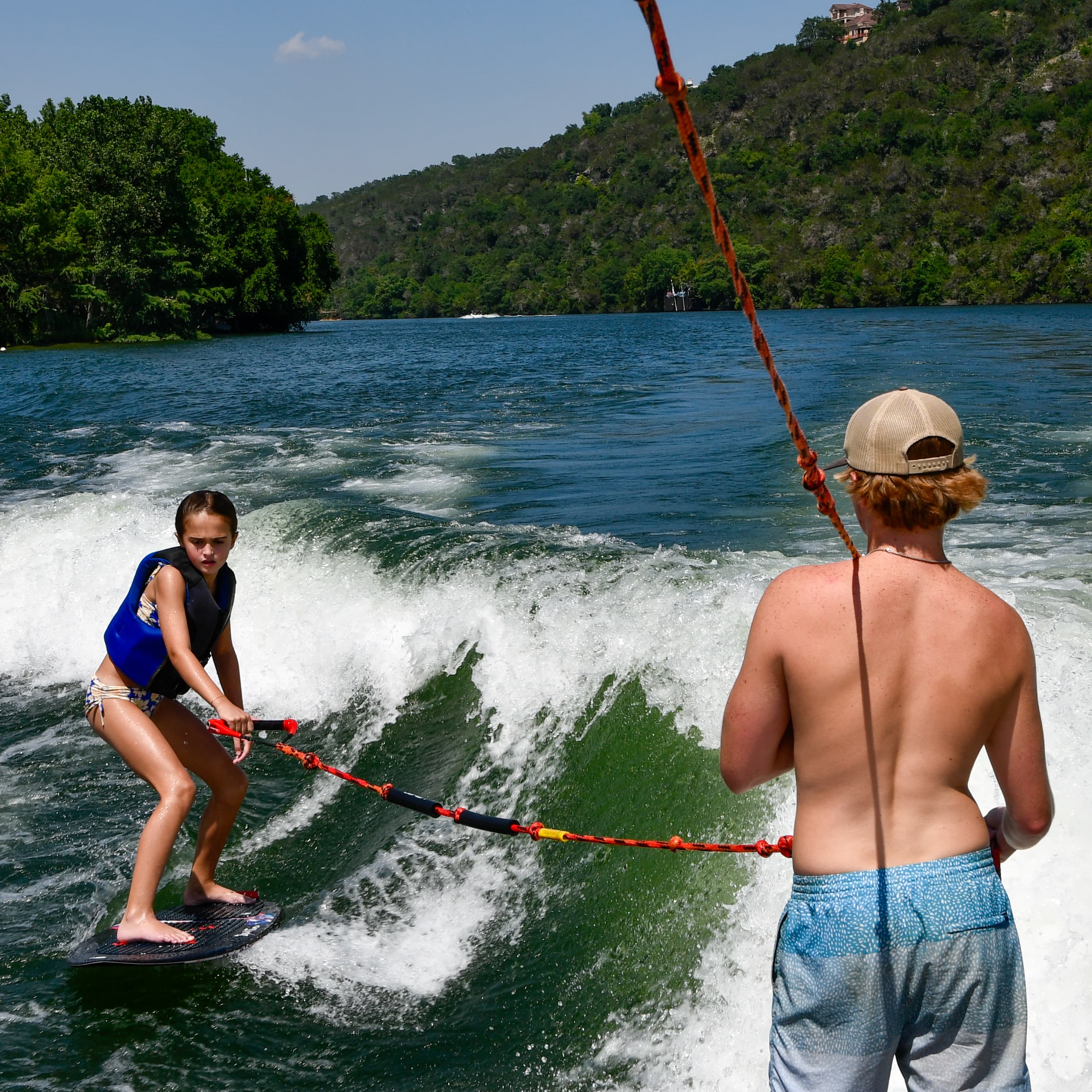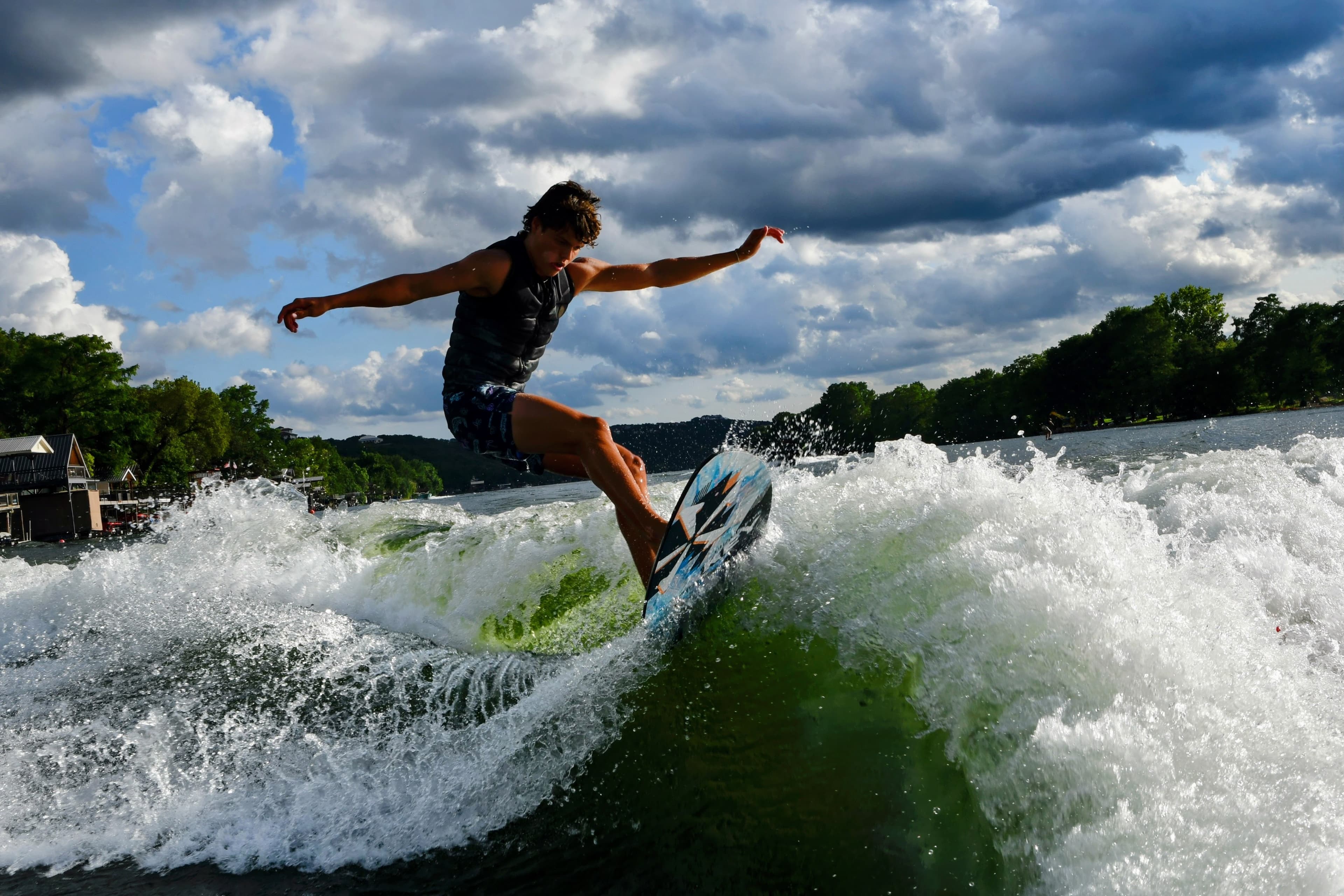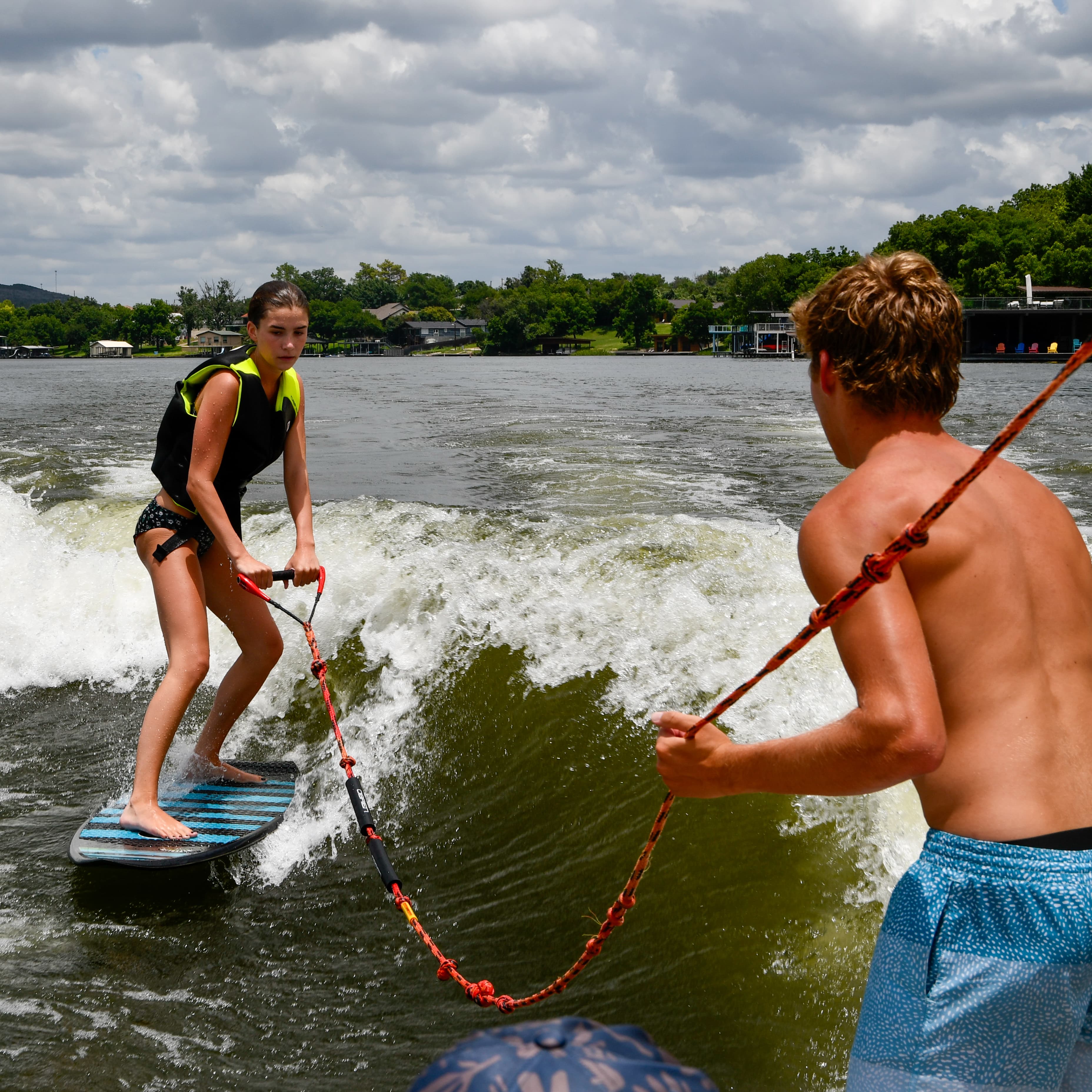
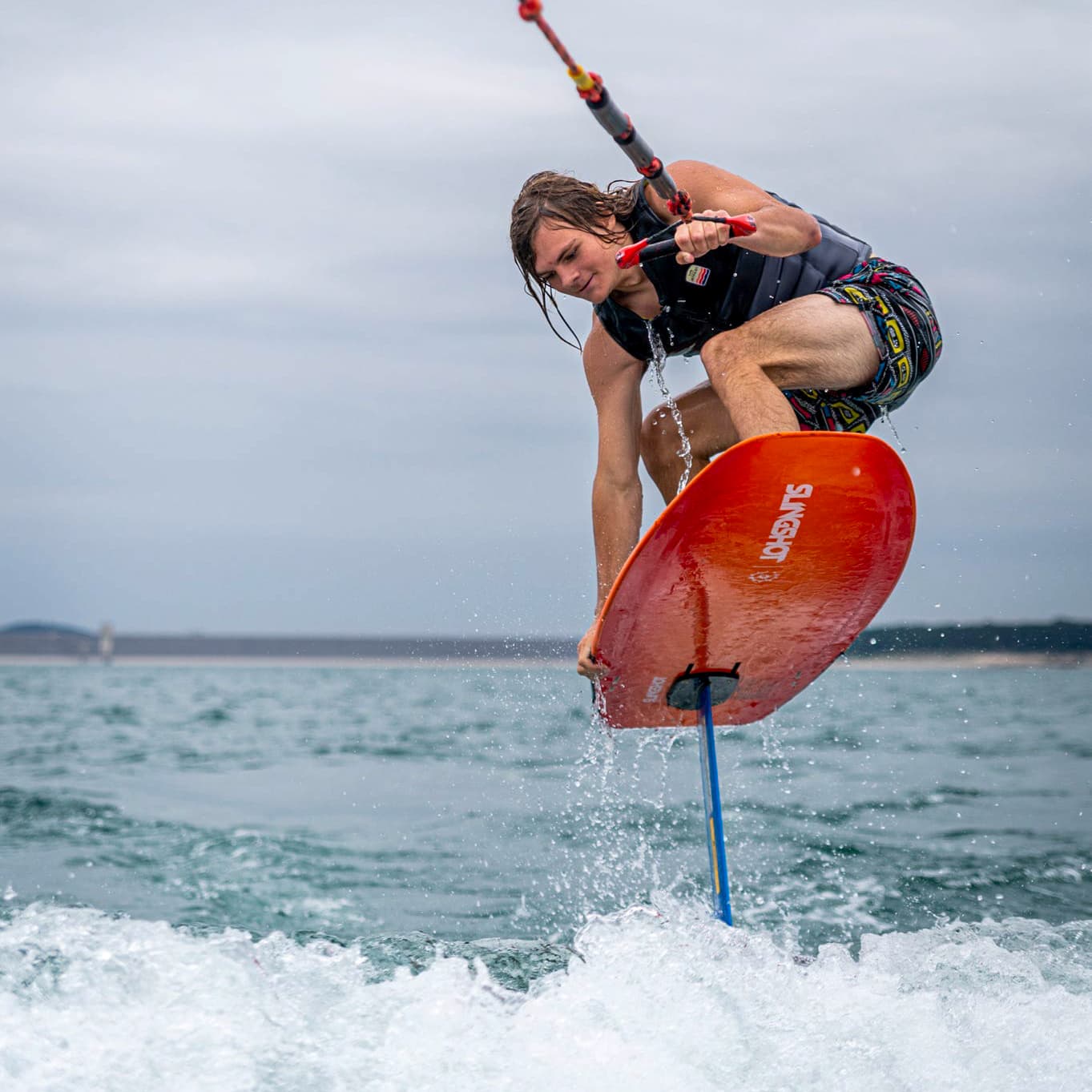
Modern wake boats use touchscreen helm displays, automated ballast systems, and GPS-locked throttle control to shape a precisely tunable surf wave — technology that has transformed wakesurfing and wakeboarding from a craft of trial and error into something closer to applied engineering.
If you have ever watched a captain tap a few buttons and conjure a head-high curl out of flat lake water, you have seen this tech at work. Here is what is actually happening beneath the fiberglass.
How Does a Wake Boat Create a Wave in the First Place?
Before the touchscreens enter the picture, it helps to understand the physics. A wake boat creates its wave through two levers: weight and hull shape.
- Weight (ballast) pushes the hull deeper into the water. The deeper the hull sits, the more water it displaces, and the larger and steeper the wave it generates.
- Hull shape and running angle determine how that displaced water rolls off the stern. Modern surf-specific hulls are designed to channel water into a continuous, breaking wave rather than a scattered rooster tail.
The position of that weight matters enormously. Load the left side and you get a wave on the left. Load the right and the wave switches sides. This is why ballast placement — not just ballast volume — is the core engineering challenge in a surf boat.
What Is a Surf System, and How Does It Steer the Wave?
Hull weight alone cannot shape a truly rideable surf wave. That is where active surf systems come in. Most modern wake boats use a deployable plate, fin, or wedge mounted at the stern that physically deflects water to build the wave on a chosen side.
Axis Boats, for example, equips its lineup with Surf Gate — a pair of carbon-fiber gates that extend into the water stream to redirect flow toward whichever side the rider is surfing. The result is a taller, longer, cleaner wave with a defined shoulder and a pocket that riders can hold without constantly chasing the rope. Competing systems from MasterCraft (Gen 2 Surf System), Malibu (Surf Gate predecessor technology), and Nautique (WAVE system) work on similar principles but differ in plate geometry, deployment speed, and integration with the boat's software stack.
The key evolution over the past decade has not been the concept — deflecting water is not new — but the precision and speed of adjustment. Early surf systems required manual lever pulls. Today's systems deploy in seconds, controlled entirely from the touchscreen.
What Does the Touchscreen Actually Control?
The helm display on a current-model surf boat is less like a car stereo and more like a tablet running specialized marine software. A single screen can manage:
| Function | What It Does |
|---|---|
| Ballast fill/drain | Opens or closes valves to water-filled tanks, shifting weight fore, aft, port, or starboard |
| Surf system position | Deploys and adjusts the stern gate or wedge to shape the wave |
| Speed control (GPS lock) | Holds a precise speed — typically 10–12 mph for wakesurfing — using GPS rather than throttle feel |
| Rider profiles | Saves a named combination of ballast, speed, and surf system settings for a specific rider |
| Wake shaping presets | Pre-programmed configurations (larger wave, mellow wave, wakeboard mode) selected with one tap |
Rider profiles are arguably the most practically useful feature. A heavier intermediate surfer who likes a steep, pushing wave and a lighter beginner who needs a softer, forgiving roller require completely different boat configurations. With profiles saved, the captain can switch between riders — and completely reshape the wave — in under a minute.
Why Does GPS Speed Matter More Than the Throttle?
Throttle position controls fuel delivery to the engine, but fuel delivery does not equal boat speed in any direct way. Wind, current, water density, hull drag, and ballast weight all shift the relationship between throttle and actual speed. On a lake like Lake Travis, where afternoon headwinds can pick up quickly, a boat held at a fixed throttle position might slow two or three miles per hour into the wind — enough to collapse the wave entirely.
GPS speed lock solves this by measuring actual over-water speed and adjusting the throttle continuously to hold the target. For wakesurfing, the difference between 10.2 mph and 11.8 mph can mean the difference between a rider stuck on the rope and one confidently surfing rope-free in the pocket. Locking speed at the GPS level removes that variable entirely and lets the captain focus on the rider rather than the gauges.
How Are Ballast Systems Engineered?
Factory ballast in a surf boat typically consists of a combination of hard tanks — polyethylene reservoirs built into the hull — and soft bags that can be wedged into storage compartments for additional weight. High-end builds can carry 3,000 to 4,500 pounds of water ballast, dwarfing the weight of any passenger load.
The filling and draining process is managed by electric pumps and solenoid valves, all controlled through the touchscreen. Better systems display real-time fill percentages for each tank so the captain knows exactly how the weight is distributed. Some boats add accelerometers and tilt sensors to auto-balance when a lopsided passenger load threatens to flatten the wave.
A note on physics: all that ballast slows acceleration significantly and increases fuel consumption. Wake boat engineers are constantly balancing surf performance against practical usability — a boat that takes three minutes to plane out is not much fun for tubing or cruising.
What Are Rider Profiles and Wave Presets?
Think of presets as the wake equivalent of a camera's scene modes. Instead of manually dialing in ballast, speed, and surf gate position from scratch every session, the captain (or even the rider via a connected app on some newer platforms) selects a saved configuration:
- "Beginner surf, goofy" — moderate ballast, 10.5 mph GPS lock, gate fully deployed port side, soft wave with a wide shoulder
- "Advanced surf, regular" — maximum ballast, 11.2 mph, gate tuned for a steeper peak
- "Wakeboard" — ballast drained to minimize wave size, speed bumped to 21–23 mph for clean symmetrical wakes
On boats with connected apps, manufacturers are beginning to allow riders to browse and download community-shared wave profiles — effectively crowd-sourcing the tuning knowledge that used to live only in an experienced captain's memory.
What Comes Next?
The near-term trajectory in wake boat tech points toward deeper software integration. Brands are exploring:
- Automated wave adjustment — sensors that detect when a rider falls and automatically hold speed until they signal they are ready
- Camera-based feedback — hull-mounted cameras that read wave shape in real time and adjust ballast to maintain a target profile
- Electrification — several manufacturers have announced or are testing electric or hybrid wake boats, though the energy demands of running 4,000 pounds of ballast at surf speed remain a significant engineering challenge
The wave that looks effortless from the shore is the product of a surprisingly dense stack of mechanical and software systems — all working together so the rider can think about nothing but the next turn.
Out on Lake Travis and Lake Austin, where the water is deep and the hill country provides a natural windbreak through most of the morning, conditions tend to reward the kind of precision that modern wake boat tech makes possible. If you want to feel what a dialed-in surf wave actually rides like, Board Bound Wake Co's private lessons are a good place to start — their 2017 Axis T23 runs Surf Gate on both sides, so the captain can build the wave around you, not the other way around.
Frequently asked questions
- What speed do wake boats use for wakesurfing?
- Most wake boats target 10 to 12 mph for wakesurfing, with GPS speed lock holding that number precisely regardless of wind or current changes.
- What is a surf gate on a wake boat?
- A surf gate is a deployable stern plate or fin that deflects water to one side of the boat, building a larger, cleaner breaking wave for the rider on that side. Axis Boats' Surf Gate is one well-known example.
- How much ballast does a wake boat carry?
- High-performance surf boats can carry between 3,000 and 4,500 pounds of water ballast in a combination of built-in hard tanks and supplemental soft bags, all managed by electric pumps controlled from the helm display.
- What are rider profiles on a wake boat?
- Rider profiles are saved combinations of ballast level, GPS speed, and surf system position that a captain can recall instantly for a specific rider, so the wave can be reshaped in under a minute between riders.